
3D product rendering for launches
Create polished product imagery before the photoshoot exists.
High-quality CGI product renders for packaging, ecommerce, retailer presentations and campaigns, shaped around accurate geometry, materials, artwork and lighting.
- Best for
- Launches, pitches and ecommerce
- Inputs
- Geometry, artwork and references
- Outputs
- Packshots and campaign scenes
A virtual product with commercial purpose
Show the finished pack while production is still moving.
3D rendering can create controlled packshots and campaign imagery before physical samples are available. It is particularly useful for launch planning, retailer decks, ecommerce and design approval.
The quality of the result depends on reliable source information. Confirmed dimensions, artwork, material references and finish notes are translated into a controlled digital model and lighting setup.
Three rendering priorities
Accuracy, material credibility and useful composition.
The render is built to support a real channel or decision, not simply to demonstrate software technique.
-
Accurate form
Use confirmed dimensions or reference geometry so proportions and artwork placement remain credible.
-
Material behaviour
Build believable glass, metal, plastic, paper, print and finish responses under controlled light.
-
Channel-ready framing
Compose packshots, transparent assets or scenes around ecommerce, presentation and campaign needs.
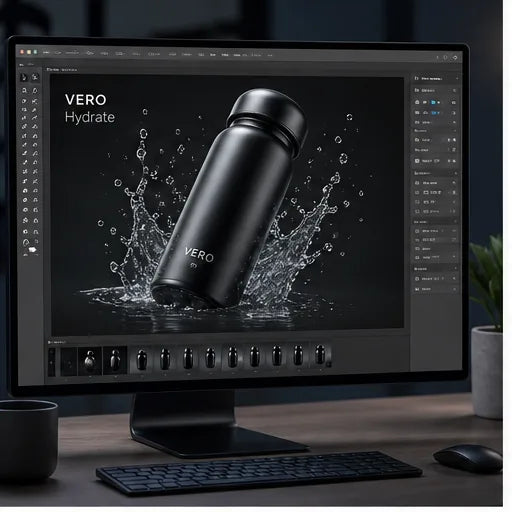

Source accuracy
A render is only as accurate as the approved inputs.
Bottle, cap, carton or pouch dimensions should come from the manufacturer where possible. Print artwork, transparency, metallic areas, embossing and surface finish need to be clearly identified.
CGI can represent an intended production result but does not replace physical sampling, colour proofing or supplier approval. Any unconfirmed feature is documented as a visual assumption.
A clear working process
From source files to final campaign exports.
-
Gather
Confirm geometry, artwork, materials, finish references, usage, aspect ratios and deadlines.
-
Build
Create or clean the model, map artwork and establish materials and lighting.
-
Review
Approve form, print placement, finish response, camera and composition through staged previews.
-
Render
Produce high-resolution final images and agreed channel-specific crops or transparent files.
Final geometry, artwork, claims, platform specifications and usage approval must be supplied or confirmed by the client before release.
3D rendering scope
Product imagery for the moments before and after launch.
The scope is based on model complexity, number of SKUs, finishes, scenes, angles, crops and final resolution.
- Product model preparation
- Artwork mapping
- Material and finish setup
- Studio packshot renders
- Lifestyle or campaign scenes
- Transparent and channel-ready exports
Before the project begins
3D Product Renders questions.
What files do you need for a 3D product render?
Ideally confirmed dimensions or CAD, final artwork, material and finish references, product examples, intended usage and required aspect ratios.
Can you work without a CAD model?
Often yes. A model can be built from reliable dimensions and references, although complex or patented geometry may require supplier CAD.
Can renders replace photography?
They can for many packshots and controlled scenes, but the right choice depends on material complexity, people, liquids, food styling, budget and the required level of physical authenticity.
Can you render several SKUs?
Yes. A shared master model and controlled artwork variants can create efficient range images once the base setup is approved.
Will the colours exactly match print?
No screen image can guarantee a physical print match. CGI can follow supplied colour values and finish references, while physical proofs remain the production reference.
Need the product visualised before launch?
Turn the approved pack into a controlled visual asset library.
Share the geometry, artwork, material references, required images and launch timing. I will identify the right modelling, review and rendering scope.